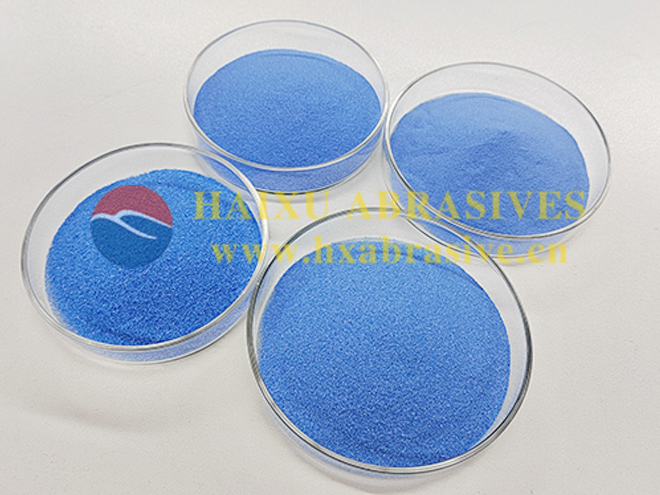
What is the advantage of Sol-gel (SG) Abrasive grain?
Sol-gel (SG) abrasive grains are not just “fancier fused alumina”; they are micro-engineered ceramics whose structure is designed at the nanometre scale during the sol-gel manufacturing route.
The key advantages that users actually see in the factory or in the field are all direct consequences of that engineered microstructure:
1. Self-sharpening = longer life and higher stock-removal
SG crystallites (≈ 0.1–0.5 µm) are 1–2 orders of magnitude smaller than those in fused Al₂O₃. When a grain fractures it breaks along the sub-micron crystallite boundaries, exposing new, sharp cutting edges instead of broad, worn flats. The wheel therefore “stays sharp” instead of glazing, so G-ratio (material removed / wheel wear) can be 3–10× higher than with fused alumina.
2. Higher hardness and fracture toughness at the same time
Dense, nano-crystalline α-Al₂O3 plus engineered second phases (e.g. MgO, Y₂O₃, ZrO₂) gives SG grains ≈ 21–23 GPa hardness (Knoop) together with KIC ≈ 4–5 MPa·m½, versus ~19 GPa and ~3 MPa·m½ for white fused Al₂O3. The grain can therefore cut high-hardness steels (>60 HRC), Ni-based super-alloys, or thermal-spray coatings without macro-fracturing.
3. Lower specific grinding energy → less burn, white-layer, residual stress
Because the grain stays sharp, rubbing and ploughing phases are reduced. Typical specific energy drops 15–30 %, so work-piece surface temperatures are lower and metallurgical damage (re-hardening burn, tensile residual stress) is greatly reduced—often eliminating an additional finishing operation.
4. Cooler cut allows higher material-removal rates
In creep-feed or high-speed grinding the limiting factor is usually burn. SG wheels can be run at 2–4× the infeed rate or wheel speed of conventional wheels before burn occurs, cutting cycle time by 30–70 %.
5. Consistent surface finish and size control
Because the wheel does not glaze or load, Ra and dimensional scatter stay stable over long production runs (Cpk improvement of 0.3–0.5 is common in automotive cam-shaft or bearing-race grinding).
6. Reduced dressing frequency and wheel consumption
Dressing intervals are typically 5–10× longer; for super-alloy turbine-blade grinding this can mean one SG wheel per shift instead of one per hour.
7. Cleaner work-piece and environment
Less wheel wear → fewer metallic inclusions in the swarf; lower grinding temperature → reduced oxidation smell and smoke; longer wheel life → less spent abrasive waste.
SG abrasive grains give you much longer wheel life at the same removal rate. In the meantime, it provides much higher removal rate before thermal damage appears. Abrasives made from SG Abrasive grain & powder simultaneously improve part quality and reducing dressing downtime.